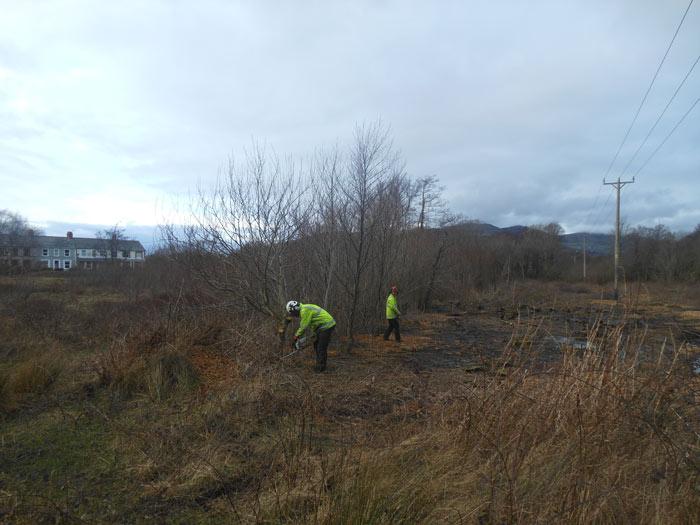
SP Energy Networks has helped RSPB on the road to restoring an unique bog in the Mawddach Valley back to its former glory.
RSPB Cymru’s Arthog bog covers almost six hectares and is renowned for its rare and special plants, like the ‘Touch-me-not balsam’ (Impatiens noli-tangere) and the nationally scarce ‘wavy St Johns wort’ (Hypericum undulatum). This was recently discovered at the site for which it is thought to be at its northern limit of its known world distribution.
Last December, whilst completing clearance of land adjacent to power lines, SP Energy Networks asked RSPB Cymru if they’d like help with clearing more of the land whilst they were at it. Graeme Decke from SP Energy Networks explains: “It just made sense; after meeting on site with the RSPB warden, and learning about the special plants and habitat that were deteriorating, we knew we could help.”
He adds: “We were clearing a section of vegetation around our high voltage lines anyway to make the power lines safer, and ensure customers continuity of electricity so we thought we’d go the extra mile and clear trees that had potential to impact our lines. This also assists in our commitment to making our network storm resistant to adverse weather conditions. In total a team of eight specially trained arborists from our vegetation contractors Amey have removed approximately five acres of trees and scrub in less than a month.”
Over many decades, Arthog bog’s habitat and wildlife has changed due to changes in management practices, particularly a reduction in grazing pressure, and trees and scrub have encroached on the site, resulting in the bog becoming dryer and the special plants being shaded out.
This means the rare peatland flora has been replaced by dense scrub, slowly suffocating the special plants that call it home. As Lesley Fletcher from RSPB Cymru explains: “We are delighted by the work SP Energy Networks have done on our behalf. The restoration of Arthog bog to it’s former glory is our objective here, but for many years it has been a very slow process of very gradual scrub removal by a team of dedicated volunteers. Also the re-introduction of pony grazing in partnership with a local farmer has helped expose the bog again.”
She adds: “The work SP Energy Networks has done has brought this work forwards in one huge leap and has saved the charity a lot of time and money. We hope to continue this wonderful work and return Arthog bog to its former glory. Our volunteers are now very busy clearing the remaining brash!”
RSPB and Natural Resources Wales (NRW) are now hoping to work together on the next stages of restoration, with future work needing to focus on removing more scrub, maintaining appropriate grazing levels, and managing water levels to keep the water table as high as it should be on a bog.
Lesley adds: “Keeping the water high will promote more specialist plants and invertebrates to recolonise and will encourage the existing rare and specialist bog plants to thrive, whilst introducing ponies to graze the regenerating scrub and the taller vegetation will help to keep it under control encouraging more open conditions.”
The Mawddach Valley volunteers are vital to this process having spent many hundreds of hours removing scrub, pulling rhododendron and clearing ditches and will work with RSPB Cymru and NRW staff over the coming years to see the bog restored to its full potential.
Arthog bog can be found within the Aber Mawddach Site of Special Scientific Interest (SSSI) and is part of the estuary feature within the Pen Llyn and Sarnau Special Area of Conservation (SAC). For more information about the site please visit the RSPB Cymru website.